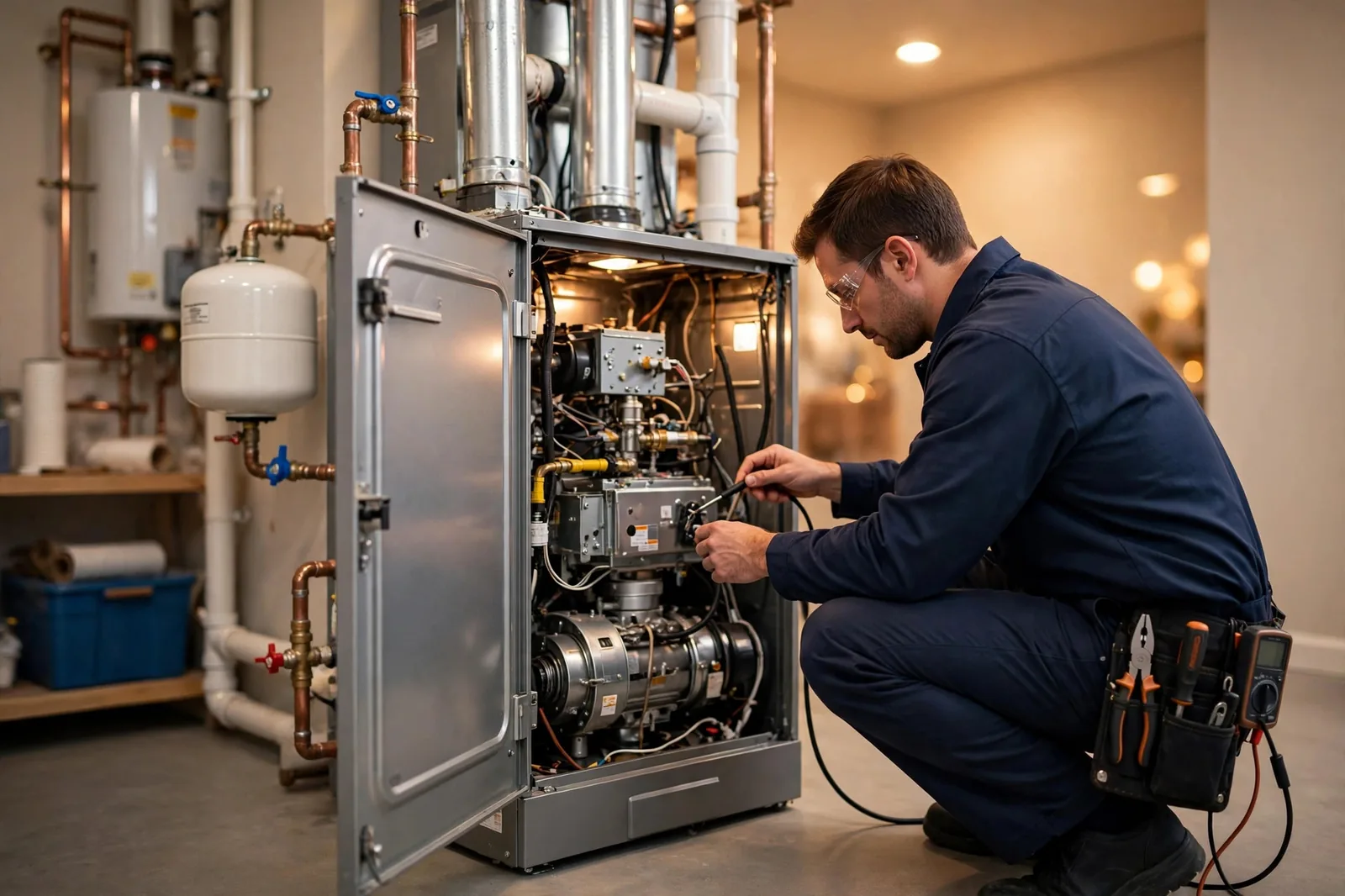
Emergency Furnace Repair in Santee, CA
Santee's inland valley location means colder winter nights than most of San Diego County, and furnaces here earn their keep from December through February. Carlton Hills, the Santee Lakes area and the Mission Gorge neighborhoods all run a mix of gas and electric heating, much of it aging. FurnaceGuard La Mesa connects Santee homeowners with independent contractors who diagnose the full heating sequence and explain the fix before work begins.
No-heat calls from Santee get priority scheduling on our East County routes. Whether it is a cracked igniter, a failed sequencer on an electric system or a thermostat that has been lying for months, call (619) 939-1577 and we will get the diagnosis on the calendar.
Common Calls From Santee
- No-heat emergencies on cold East County nights
- Gas furnace ignition and flame sensing failures
- Electric furnace heat strip and sequencer problems
- Thermostat misreads and short cycling
- Seasonal tune-ups before the heating season
ZIP Codes Served
Neighborhoods We Serve in Santee
Santee sits in an inland valley northeast of La Mesa, and that valley geography shapes everything about heating here. Cold air pools in the valley on clear winter nights, so Santee furnaces work harder than their coastal cousins. We run daily routes through Santee from our La Mesa base, and we know the neighborhoods block by block.
Carlton Hills, in the eastern part of the city along Carlton Hills Boulevard, is one of Santee's signature neighborhoods: one-story, two-story, and split-level homes in a Southern California style with shingled rooflines and terra cotta touches, most dating to the 1960s and 1970s. These are classic gas-furnace homes, and the systems are now at the age where igniters, flame sensors, and blower motors fail in clusters. The split-level layouts add a wrinkle: heat rises to the upper level while the lower level stays chilly, which often reads as a furnace problem when it is really an airflow and duct balance issue. Our technicians test airflow as part of every Santee diagnosis for exactly this reason.
Around Santee Lakes and the Town Center district, the housing is newer and denser, with townhomes and planned developments running modern equipment that mostly needs scheduled maintenance. The Mission Gorge corridor along the southern edge mixes older ranch homes with commercial frontage, and the furnaces there tend to be older and less maintained. Mast Boulevard runs the length of the city and ties it all together; if your home sits anywhere along that corridor, from the western neighborhoods near the 52 freeway to the eastern streets approaching the lakes, you are squarely in our daily service area. Out toward the city's eastern edge, larger lots and longer duct runs make weak airflow more visible: far rooms that never warm up, furnaces that overheat and trip their safety limits.
We serve all of Santee, including ZIP codes 92071 and 92072. Call (619) 939-1577 and tell us your cross streets. Chances are we were on your block this week.
Santee Weather and Your Furnace
Santee's inland valley location makes it one of the colder winter spots in our service area. When La Mesa sees a mild 50-degree night, Santee can sit several degrees lower, and that difference shows up directly in furnace run times.
The broader climate is semi-arid steppe: winter daytime highs in December and January around 65 to 66 degrees, nighttime lows from 44 to 50 degrees across the region, with the coldest nights dipping into the mid-30s. Santee lives at the cold end of that range. Cold air is heavy, and on clear, still winter nights it drains into the valley and pools there, which is why a Santee homeowner can wake to frost on the windshield while friends closer to the coast see none. About 12 inches of rain falls in a typical year across roughly 261 sunny days, and August brings the year's peak heat with highs around 83 degrees.
For furnaces, the valley effect means two things. First, the heating season starts earlier and ends later than on the coast: Santee systems often fire in November and still cycle in March. Second, the coldest nights push marginal equipment past its limits. A furnace with a weakening igniter might survive a 50-degree night in La Mesa and fail on a 38-degree night in Santee. The long idle summer compounds the problem. From late spring through early fall, Santee furnaces sit silent while dust accumulates on burners and sensors. Santa Ana winds in autumn drive that dust deeper into the equipment. Then the first valley cold snap hits, and every neglected system in Carlton Hills and around the lakes tries to fire at once. The failures follow within days: no ignition, short cycling, cold air from the vents.
The pattern is predictable, which means it is preventable. A fall tune-up clears the summer's dust, tests the ignition sequence, and verifies the safeties before the valley cold arrives. Schedule in October and beat the December rush.
Homes and Heating Systems in Santee
Santee is a city of single-family ranch homes, and most of them heat the same way: with a gas furnace in the garage or a closet, connected to the house by original ductwork.
The Carlton Hills tracts and the surrounding 1960s and 1970s neighborhoods are the heart of our Santee call volume. These homes were built with standard gas furnaces that have, in many cases, been replaced once already. The second-generation systems are now aging, and the failure pattern is consistent: hot-surface igniters that crack after years of thermal cycling, flame sensors coated in oxidation that shut the burner down seconds after ignition, and blower motors with worn bearings that growl louder each winter. Because many of these homes have split-level or two-story layouts, we also see a lot of comfort complaints that trace to ductwork rather than the furnace itself: crushed flex duct in the attic, disconnected runs, and returns that are undersized for the system.
Newer construction around Town Center and the eastern developments runs high-efficiency condensing furnaces. These are good systems, but they have their own maintenance needs: condensate traps that clog with algae, pressure switches that trip when intake pipes get blocked, and control boards that are sensitive to power fluctuations. Santee also has a meaningful number of electric furnaces and heat-pump systems, particularly in townhomes and condominiums, where gas was never run to the unit. Those systems fail at the sequencer, the heat strips, or the thermostat wiring, and they need a technician who is comfortable with electric heat, not just gas. Our network includes contractors experienced with both fuel types, and every diagnosis covers the thermostat, the controls, and the airflow, not just the box in the garage.
If your Santee home has hot and cold spots, a furnace that cycles too often, or a system that simply will not start, give us a call. Describe the symptoms and we will schedule a full-sequence diagnosis.
When Santee Homeowners Call Us Most
In Santee, the furnace calendar runs a little longer than elsewhere, because the valley cold arrives earlier and lingers later.
October is tune-up month. Homeowners who learned the hard way last winter book early, and this is genuinely the best time: open schedules, full parts availability, and mild weather that makes attic and rooftop work pleasant. November brings the first valley cold snaps, and with them the first wave of no-heat calls from systems that sat idle all summer. December through February is the heart of the emergency season. This is when Santee's colder nights separate the healthy furnaces from the marginal ones, and when we see the most ignition failures, cracked heat exchanger concerns, and blower motor deaths. March is the shoulder: the cold eases, but systems weakened by three months of steady cycling keep failing, and many homeowners use the moment to plan replacements without winter pressure.
From April through September, the phone quiets on the repair side, which makes summer the smart season for planned work. A replacement quoted and installed in July means a new system, tested and ready, long before the first November cold snap. Whatever the season, one call to (619) 939-1577 gets the process started.
Understanding Santee's Valley Cold
The single most important thing to understand about heating in Santee is the valley effect: cold air pooling on clear winter nights, making Santee colder than the surrounding hills.
Cold air behaves like water. On a clear, calm winter night, the ground radiates heat to the sky, the air in contact with the ground cools, and that heavy cold air flows downhill and collects in the lowest spots. Santee's valley floor is one of those collection points. The result is a reliable pattern: on nights when La Mesa reports a low in the upper 40s, Santee can wake to the low 40s or upper 30s, with frost on windshields and lawns while the hillsides above stay clear. This is not a rare event. It happens on many clear nights each winter, and it is the reason Santee furnaces log more run time than systems just a few miles west.
For your furnace, the valley cold has two consequences. First, the system runs longer cycles on those cold nights, which accelerates wear on every part that moves or heats: the igniter, the blower motor, the gas valve, the control relays. Second, the coldest nights are when marginal parts fail, which is why Santee's no-heat calls cluster on the clearest, coldest nights of December and January rather than spreading evenly through the season. A flame sensor with a season's worth of oxidation might prove flame fine at 48 degrees and fail at 38 degrees. The ten-degree difference is the whole story.
The practical takeaway is that Santee homeowners should treat furnace maintenance as cold-weather preparation, not as a chore. A fall tune-up that cleans the flame sensor, tests the igniter, and verifies the heat exchanger is specifically preparation for those valley-cold nights. Call (619) 939-1577 in October, and your system will be ready for the coldest air in the service area.
Find Us From Anywhere
Maps and Directions for Santee
Coming from the airport, riding the trolley, or driving over from anywhere in the county, these maps show the way to Santee. Our technicians run the same routes every day.
In Santee and need heat tonight? Call now. Call (619) 939-1577
Call NowNearby Service Areas
Helpful Furnace Guides
Santee Furnace Repair: Common Questions
What Santee homeowners ask before booking a furnace visit.
Ask by PhoneHow fast can you reach Santee?
No-heat calls get priority scheduling across our East County routes. Call (619) 939-1577 and you will get the next available window for Santee and the surrounding area.
Do you service both gas and electric furnaces in Santee?
Yes. Our network's independent contractors diagnose and repair gas furnaces, electric furnaces and air handler systems, plus thermostats and controls.
What does the diagnosis include?
Testing the full heating sequence: thermostat call, power and safeties, ignition, flame sensing and airflow. You get the findings explained and a written plan before any work begins.
Can I schedule maintenance before winter?
Yes, and fall is the best time. A tune-up cleans burners and flame sensing, tests the blower and safeties, and verifies carbon monoxide safety before the heating season.
Need Furnace Repair in Santee?
Call FurnaceGuard La Mesa at (619) 939-1577 and get the diagnosis scheduled.